

Intentional Injury Investigations – Revealing the Truth through Evidence
Intentional injury cases are often not just physical interventions; they are complex cases shaped by mutual claims, conflicting statements, and evidence open to different interpretations. For proper evaluation of such cases, not only medical reports but also crime scene findings, camera recordings, witness statements and the nature of the impact must be analyzed together.
As DNA Criminal Informatics, we examine intentional injury claims using scientific methods, adhering to the principle of impartiality, and with technical reports that support legal processes. Our aim is not only to reveal how the incident occurred but also to clearly demonstrate the perpetrator’s intent, the victim’s damage, and the true nature of the incident. Because justice requires illuminating the truth in all its dimensions.
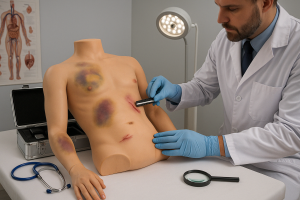
Forensic Medical Assessment of the Degree and Nature of Injury
In intentional injury cases, the degree of injury and how it occurred directly affects the legal qualification of the incident. Is the injury minor, affecting vital functions, or does it cause permanent marks or life-threatening conditions? The answer to these questions is not just a medical assessment; it is also critical for determining the legal aspect of the incident.
As DNA Criminal Informatics, we examine injury cases not just with a few sentences written in reports; we evaluate them by considering the dynamics of the incident, physical characteristics of the injury, and details of medical findings together.
Main Elements We Address in our Investigation Process:
- Injury Classification
- Is it a minor injury, life-threatening, or has it caused permanent damage?
- We answer these questions according to forensic medicine standards, with objective and scientific criteria.
- Analysis of Trauma Formation
- How did the injury occur? Was it from a sudden reaction, planned attack, or during self-defense?
- The direction of injury, angle of impact, and degree of force used are analyzed to create an occurrence scenario.
- Technical Interpretation of Medical Reports
- Is there any inconsistency between the incident description and medical reports?
- Do descriptions like “superficial scratch,” “deep tear,” “blunt force trauma” match the severity of the incident?
- Impact Area and Functional Consequences of the Injury
- How has the injury affected the person’s daily life, work capacity, or organ functions?
- Factors such as permanent marks, loss of function, or need for long-term treatment are examined in detail.
Contribution of this Assessment to the Legal Process
Without clarifying the nature of the injury, the perpetrator’s degree of intent or the victim’s damage cannot be correctly determined. This increases the risk of erroneous decisions in the judicial process.
As DNA Criminal and Forensic Informatics, we analyze and evaluate medical data, integrating it with legal interpretation to provide reliable, technically sound reports for both defense and prosecution. Because the depth of a wound leaves its mark not only on the body but also in the administration of justice.
Consistency of Suspect and Victim Statements with Crime Scene Findings
In intentional injury cases, party statements are often the most controversial and ambiguous aspect of the incident. While the suspect may claim self-defense, the victim may allege a deliberate attack. At this point, the accuracy of statements should be tested not only through narratives but also by evaluating them together with crime scene findings, physical evidence, and medical reports.
As DNA Criminal and Forensic Informatics, we analyze suspect and victim statements comparatively with all technical data of the incident; we reveal whether the described scenarios align with scientific reality.
Basic Elements We Consider in our Examinations:
- Time and Space Consistency
- Do the stated incident time, spatial arrangement, and action sequence match with crime scene findings?
- Can the duration of physical contact, direction, and positions of parties be explained consistently with statements?
- Physical Marks and Evidence Matching
- Are the shape, location, and severity of the injury consistent with the described form of impact?
- Do crime scene data like blood stains, furniture arrangement, and struggle marks support the narrative?
- Detection of Contradictory or Exaggerated Statements
- Are there logical errors, excessive detailing, or unrealistic narratives in the statements?
- Are there inconsistencies between statements given at different times about the same incident?
- Support from Witness and Camera Recordings
- Are there witness statements, visual recordings, or audio evidence that align with or contradict party statements?
- Psychological Impact and Statement Reliability
- Could factors like fear, anger, or giving statements under pressure have affected the content?
- Is there any attempt to deliberately mislead or create a perception of victimization?
Why is this Investigation Important?
Statements, reflecting the unseen side of the incident, are often directive and interpretative. However, a statement can only be considered reliable if it is supported by concrete evidence.
As DNA Criminal and Forensic Informatics, we examine party statements in light of scientific evidence; we provide clear answers not just to “who said what” but to “do the statements align with the evidence?” Because statements may change, but evidence always tells the truth.
Determination of Tool Nature and Intent to Injure
In intentional injury crimes, determining the perpetrator’s degree of intent depends not only on the victim’s damage but also on the nature and effect of the tool used. Because deciding whether an action was “intentional” or “negligent” requires technical evaluation of how, with what, and with what intensity the injury was inflicted.
As DNA Criminal and Forensic Informatics, we examine any cutting, piercing, crushing, or impact-causing tool used in the incident; we conduct scientific analyses to illuminate how the incident occurred.
Basic Elements We Address in our Examination:
- Tool Type and Injury Potential
- Objects like knives, screwdrivers, sticks, stones, glass pieces are evaluated according to legal and forensic medical classification.
- The tool is analyzed based on whether it carries “intent to kill,” its weight, sharpness, and method of use.
- Tool Usage Method and Injury Location
- How was the tool held, how many times was it used, which area was targeted?
- It’s evaluated whether the injury was directed at vital areas like head, neck, chest.
- Action Intensity and Control
- It’s analyzed whether the perpetrator executed the action under control or as a sudden reaction.
- It’s determined if there were multiple strikes and if there was increasing intensity between strikes.
- Whether the Tool Was Ready or Consciously Selected
- Was a specific object brought to the scene for injury, or was an object found at the scene used?
- This can reveal the perpetrator’s premeditation.
- Distinction between Intent, Consent, and Possible Intent
- It’s analyzed with technical reports whether the perpetrator executed the action knowingly and willingly, or accepted potential consequences.
Why is this Analysis Important?
The distinction between intentional and negligent injury directly affects the direction of the legal process. Similarly, the characteristics and effect of the tool used reveal to what extent the perpetrator acted with intent.
As DNA Criminal and Forensic Informatics, we evaluate objects used in the incident not just as “tools” but as key evidence of the incident, preparing scientific reports that clarify the perpetrator’s intent with technical data. Because intent is understood not just through intention but through technical traces behind the action.
Technical Examination for Self-Defense and Unjust Provocation
One of the most important factors determining criminal responsibility in intentional injury cases is whether the action occurred under self-defense (right of defense) or unjust provocation. However, these situations emerge only when analyzed together with physical traces of the incident, nature of evidence, degree of force used, and timing elements. Because like every attack, every defense has its limits; exceeding these limits can completely change the legal qualification.
As DNA Criminal Informatics, we technically examine claims of self-defense and unjust provocation in intentional injury cases; we provide scientific analyses supported by evidence that can be legally interpreted.
Main Elements We Consider in our Analysis:
- Starting Point of Action and Who Made the First Intervention?
- It’s determined who initiated the attack.
- Triggering behaviors and timing of mutual intervention are analyzed.
- Proportionality of Force Used
- Is the action claimed as defense proportional?
- Was it aimed at stopping the attack, or did it turn into violence?
- Psychological and Emotional Background of the Incident
- Are reactions given under momentary anger, panic, or fear involved?
- Is there verbal or physical provocation that could constitute unjust provocation?
- Consistency of Injury Pattern with Right of Defense
- Is the victim’s injury pattern consistent with the claimed defense narrative?
- Could strikes directed at vital areas indicate exceeding defense limits?
- Scientific Testing of Alternative Scenarios
- Reconstruction of actions claimed to be done under defense or provocation through technical analysis.
- Scientific comparison of which scenario is more probable in light of evidence.
Why is this Assessment Necessary?
Self-defense or unjust provocation, when correctly determined, can result in significant sentence reduction or complete innocence. However, an impartial examination based on technical evidence is essential for correct interpretation of these claims.
As DNA Criminal Informatics, we focus not just on the surface of events but on underlying dynamics. By evaluating the limits of the right of defense, proportionality of force used, and the entirety of the incident in light of evidence, we reveal the scientific aspect of truth. Because a fair decision is only possible with objective analysis.
Impact of Forensic Documents, Images, and Technical Reports on Legal Process
The healthy functioning of the legal process in intentional injury cases depends not only on narrating the moment of incident but on supporting this narrative with evidence. At this point, medical reports, crime scene images, camera recordings, and technical analysis documents play a decisive role in understanding how the incident occurred and reaching a fair conclusion in the judicial process.
As DNA Criminal Informatics, we evaluate all obtained documents using independent and scientific methods, preparing technical reports suitable for court submission by ensuring re-examination of uninterpreted or inadequately interpreted evidence.
Documents We Address in our Examination and our Contributions:
- Scientific Analysis of Forensic Medical Documents
- Report findings like impact marks, fractures, tissue damage are interpreted not just medically but forensically.
- Medical definitions in reports are correlated with the incident to determine perpetrator’s intent and attack severity.
- Technical Examination of Crime Scene Photos and Video Recordings
- Camera footage is synchronized with timestamps, analyzing movement direction, contact moment, and impact duration.
- Impact direction, positions, and distances are evaluated through photos using technical software.
- Reporting Process for Evidence Presentation
- All technical examinations are transformed into written reports, simplified, suitable for legal language, and as expert opinions.
- Prepared reports can be submitted to court by defense or prosecution as expert evaluation.
- Corrective Examination of Incomplete or Incorrectly Interpreted Documents
- Interpretation errors, methodological deficiencies, or assessment inconsistencies in previously prepared reports are scientifically identified.
- Overlooked data is made visible, enabling re-evaluation of evidence.
- Impact of Reports on Judicial Process
- Technical reports guide the court in determining degree of intent, defining action severity, and concretizing elements affecting penalty amount.
Why is this Process Important?
For correct decisions in judicial processes, technical data must be presented clearly and comprehensibly, translated into legal language. Otherwise, important evidence might remain just a detail or be misinterpreted.
As DNA Criminal Informatics, with our expert team, we contribute to strengthening defenses and ensuring court decisions are based on truth by reporting images, documents, and evidence in an understandable, systematic, and legally valid manner.
Because justice is shaped not just by what is told, but by what can be proven.
The Foundation of Justice is Established through Scientific Examination
A fair and correct judicial process in intentional injury cases is possible not only through party statements but through analyzing evidence with scientific methods and establishing it on legal grounds. The form of injury, perpetrator’s intent, nature of tool used, and all details of the incident; material truth emerges only when evaluated with an interdisciplinary, impartial, and technical perspective.
As DNA Criminal and Forensic Informatics, we contribute to justice being served in intentional injury cases through our expert analyses, technical reports, and objective assessments. Reaching the truth is not just a right; it’s a process that must be conducted with correct methods.
If you want to reveal the truth behind the incident with a strong report based on scientific and legal foundations, contact us.
Frequently Asked Questions (FAQ)
Brief summary: DNA Criminal Informatics produces impartial, technical, and court-submittable reports in intentional injury cases by evaluating medical findings, crime scene data, camera recordings, and party statements together. Scientific method, chain evidence analysis, and visual/computational reconstruction are our core approach.
1) What is Intentional Injury Crime, in which Law is it Regulated?
Intentional injury is the act of causing pain to a person’s body or disrupting their health/perception ability. It is regulated in Turkish Criminal Code (TCK) Art.86 and aggravated consequences in Art.87. With 2025 amendments, some minimum penalty limits have been increased. Attorney Baran Dogan+1
2) What are the Penalties?
Penalties vary according to injury severity, qualifying circumstances, and 2025 amendments. For injuries treatable with simple medical intervention (TCK 86/2), 6 months–1.5 years imprisonment or judicial fine; for basic form (TCK 86/1), 1.5–3 years imprisonment. (Minimum limit is 9 months when committed against women.) In injury with aggravated consequences (TCK 87), increase provisions apply.
3) What Does “Treatable with Simple Medical Intervention” Mean?
It refers to clinical conditions where injury effects can be treated with simple medical intervention (e.g., short-term dressing, stitches); TCK 86/2 assessment is made in the case. Definitive classification is made through forensic medical evaluation and directly affects the legal qualification of the incident.
4) is Intentional Injury Subject to Complaint, What is the Complaint Period in Months?
The basic state (86/1) is not subject to complaint; the prosecution investigates ex officio. Cases requiring simple medical intervention (86/2) are subject to complaint, and the complaint period is 6 months from the date of learning about the perpetrator and the act.
5) is Reconciliation (Mediation) Possible?
Yes. According to the current list of the Ministry of Justice, TPC 86/1 and 86/2 are within the scope of mediation. The prosecution initiates the mediation process based on the nature of the case.
6) under What Conditions is Self-Defense Accepted?
There must be an ongoing or imminent unlawful attack, and the defense must be proportional and necessary (TPC 25). Different legal consequences may arise if these limits are exceeded. We scientifically test self-defense claims using technical data such as strike direction, angle, force, and timeline.
7) What is the Difference between “Unjust Provocation” and Self-Defense?
Self-defense requires an ongoing attack and proportionality; in unjust provocation, the perpetrator’s state of anger/grief may be grounds for sentence reduction. Technical data (number of strikes, targeted area, choice of weapon, etc.) strengthens this distinction.
8) how are Determinations like “Permanent Mark” and “Life-Threatening Condition” Made?
TPC 87 considers outcomes such as permanent facial marks, loss of organ function, life-threatening conditions, premature birth, etc. as “aggravated injury due to its consequences.” Specialist medical reports, visual analysis, and event dynamics are evaluated together.
9) are Camera Footage/Phone Recordings Considered Evidence?
Evidence obtained through legal methods can be evaluated in court; evidence obtained through illegal means cannot be used for judgment (CPC 206/2-a, 217/2; Constitution 38/6). Therefore, the method of obtaining recordings is critically important.
10) What Happens if Medical Reports Conflict with Statements?
Statements are cross-checked with injury type/location, blood stain patterns, struggle marks, video timestamps, and medical definitions in reports. Scientific conflict detections are illuminating for the court (e.g., inconsistency between a “superficial scratch” definition and high-intensity violence narrative).
11) why is the Weapon Used (Knife, Stick, etc.) Important in Determining Intent?
The type of weapon, number of strikes, and targeted area affect assessments such as proportionality, control, and possible/probable intent. Weight, sharpness, and accessibility (whether deliberately brought to the scene) are technically analyzed.
12) how is the Distinction Made between “Intentional Injury” and “Attempted Murder”?
Targeting vital areas, strike force/number, weapon lethality, post-incident behavior, and event flow are evaluated together. Forensic medicine and event reconstruction are decisive in this distinction on a case-by-case basis.
13) What Documents should You Submit to Us?
All medical documents (epicrisis, forensic report, imaging, etc.)
Crime scene photos/videos and timestamped camera recordings
Witness information and statement samples
Scene sketch or inspection/reports (if available)
14) how Does your Technical Report Process Work?
Preliminary review & scope → identification of missing evidence
Forensic medical analysis → injury degree/mechanism
Event reconstruction → strike direction, angle, distance, time
Statement consistency analysis → narrative-evidence cross-referencing
Report preparation → clear, visually supported, court-appropriate format
15) What Happens if I Withdraw My Complaint?
In crimes requiring complaint (e.g., TPC 86/2), withdrawal may dismiss the case unless legally specified otherwise (TPC 73/4). It has no effect in non-complaint cases. Consult your lawyer for your specific case. Attorney Baran Doğan
16) how should I Deliver Evidence to You? (Chain of Custody)
We recommend transferring original digital files without copying, avoiding meta/data loss, and preferably with hash values. Physical materials are received with proper packaging and registration forms; the entire process is documented according to “chain of custody” principles.
Why DNA Criminal Informatics?
Impartial and scientific methodology
Multidisciplinary team (forensic medicine, physical evidence analysis, image/flow analytics)
Court-compatible technical report format and visual presentation
Objective evaluation with equal distance to defense or prosecution
Contact: Let us technically evaluate your case; complete missing evidence and make the truth visible on scientific grounds.
Contact
 For technical support, forensic reporting, and professional defense;

 0552 676 11 00